

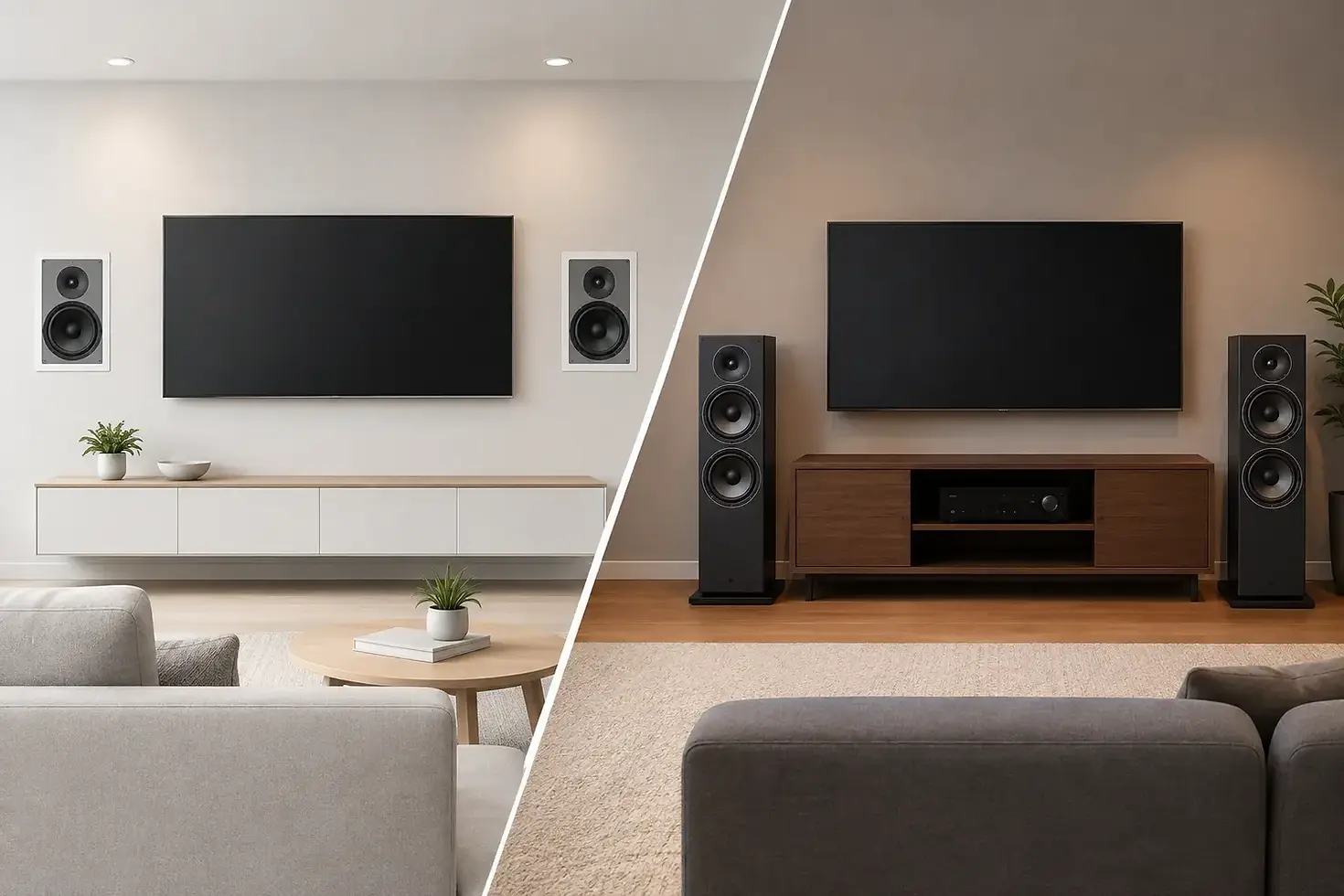
Triad In-Wall Speakers vs Traditional Speakers

A beautifully designed room can lose its balance quickly when floorstanding speakers, stands, and exposed cables compete with the architecture. That is why the question of Triad in-wall speakers vs traditional speakers is not simply about where sound comes from. It is about how a home looks, how it performs, and how easily entertainment fits into everyday life.
For a dedicated listening room, a pair of traditional speakers may be exactly right. For a clean-lined great room, a whole-home music system, or a theater designed around the screen rather than speaker cabinets, Triad in-wall speakers offer a distinctly different approach. The best choice depends on the room, the listening priorities, the construction details, and the level of performance you expect.
Triad In-Wall Speakers vs Traditional Speakers: The Core Difference
Traditional speakers are self-contained cabinets placed in the room. Their enclosure, drivers, crossover components, and physical position are all visible and accessible. Bookshelf, tower, on-wall, and stand-mounted models fall into this category. They can be moved, angled, upgraded, or taken with you when you relocate.
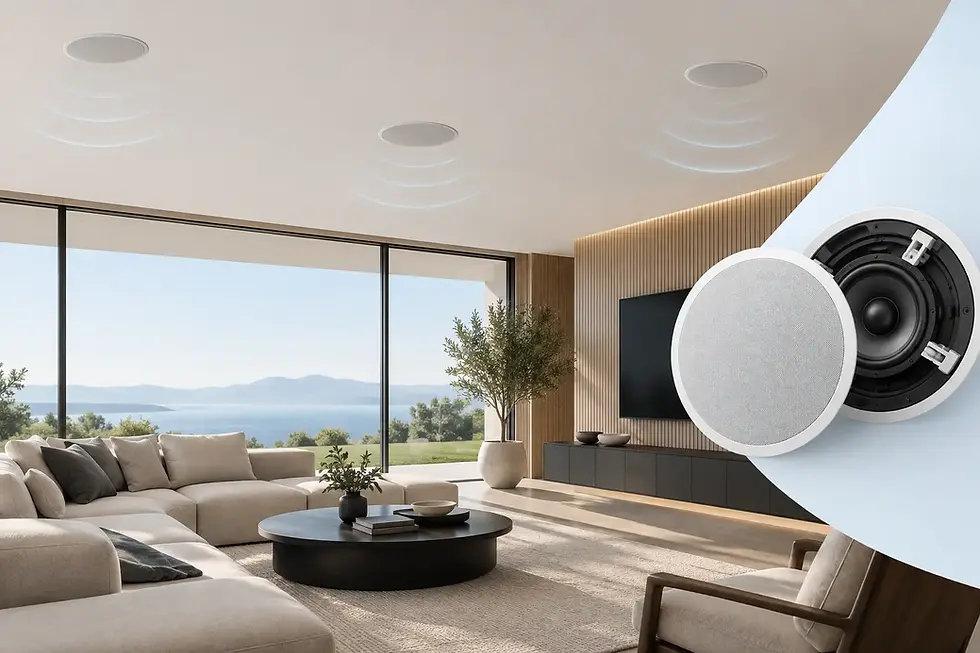
Triad in-wall speakers are built into the wall structure, with grilles that can often be painted to match the surrounding finish. Rather than treating speakers as furnishings, they become part of the architectural plan. Triad is particularly well suited to custom installations because its speaker solutions are designed around controlled performance, purpose-built enclosures, and the needs of high-end media rooms and whole-home audio systems.
Neither category is automatically superior. A well-designed conventional system can be exceptional, especially when the room supports ideal speaker placement. A properly engineered in-wall system can be equally compelling while preserving the visual simplicity many homeowners want. The difference is in the design process.
Sound Quality Depends on Design, Not Visibility
A common assumption is that in-wall speakers cannot deliver the depth, impact, or refinement of traditional cabinets. That can be true with basic architectural speakers installed directly into open wall cavities. The wall becomes an uncontrolled enclosure, and inconsistent construction can affect bass response, resonance, and sound isolation.
Triad approaches this differently. Many of its in-wall solutions use purpose-built enclosures that create a more predictable acoustic environment behind the speaker. This helps the system produce more consistent performance from room to room and reduces the variables introduced by framing, insulation, and wall depth. For homeowners who want high-performance sound without visible speaker boxes, that engineering matters.
Traditional speakers still have advantages in certain applications. Their cabinets are designed as complete acoustic systems, and premium models can offer substantial internal volume, deep bass capability, and carefully tuned dispersion. In a two-channel listening room, they may allow more freedom to experiment with placement until the stereo image feels precisely right.
But sound quality is never just a product specification. Room dimensions, seating location, surfaces, amplification, subwoofer design, calibration, and speaker placement all affect the experience. A carefully planned Triad in-wall system can outperform an expensive traditional system placed wherever space happens to allow.
The role of speaker placement
Traditional speakers give you flexibility after installation. You can move them farther from a wall, change toe-in, or rearrange a room if the sound feels too bright, narrow, or bass-heavy. That flexibility is valuable for enthusiasts who enjoy adjusting their system over time.
In-wall speakers require the right decisions before drywall is closed. Their positions should align with the seating plan, display location, ceiling height, furniture layout, and room acoustics. Once installed, they are not easily moved. This is where professional planning pays off: permanent placement becomes a strength when it is intentional.
A Better Fit for Design-Forward Spaces
For many luxury homes, visual calm is a major part of the brief. Open-concept living areas, custom millwork, expansive windows, and carefully selected furnishings leave little room for audio equipment that feels like an afterthought. In-wall speakers can deliver music and cinematic sound while letting the room remain focused on its architecture.
Triad in-wall speakers are especially compelling in spaces where multiple technology elements need to coexist. A great room may need distributed music, television audio, surround sound, lighting scenes, motorized shades, climate control, and reliable Wi-Fi coverage. Integrating speakers into the walls reduces visual clutter and creates a more unified result.
Traditional speakers can also complement a design-forward home, particularly when they are selected as intentional furniture pieces. Some homeowners appreciate the craftsmanship and visual presence of high-end loudspeakers. In a library, den, or dedicated music room, visible speakers can make a clear statement about the purpose of the space.
The question is whether the speakers should be a feature or disappear into the room. There is no wrong answer, but it should be decided early enough to support the architecture.
Installation Is the Biggest Practical Trade-Off
Traditional speakers are generally simpler to install. They need appropriate placement, power and signal connections, and sometimes stands or furniture, but they do not require cutting into finished walls. This makes them attractive for existing homes, temporary setups, or spaces where renovation is not planned.
In-wall speakers demand more coordination. Wiring must be routed before walls are sealed or opened carefully in an existing home. Framing, plumbing, electrical runs, insulation, and fire ratings all need consideration. In a theater or media room, speaker locations must also work with the screen, seating tiers, acoustic treatments, and equipment location.
That level of planning should not be viewed as a drawback when a home is being built or remodeled. It is an opportunity to create infrastructure that supports the way you intend to live. Prewiring for future zones, surround channels, outdoor audio, subwoofers, and networked control can prevent disruptive retrofits later.
For an existing home, an experienced integrator can assess what is realistically possible before recommending an approach. Sometimes in-wall speakers are an excellent retrofit. In other situations, on-wall or traditional speakers may provide better performance with less disruption.
Whole-Home Audio and Smart Control
In-wall speakers are a natural fit for whole-home audio because they can be placed where music is wanted without consuming floorspace. Kitchens, hallways, bedrooms, patios, bathrooms, gyms, and entertaining areas can each become distinct listening zones. The goal is not to fill every room with sound. It is to make sound available where it improves the moment.
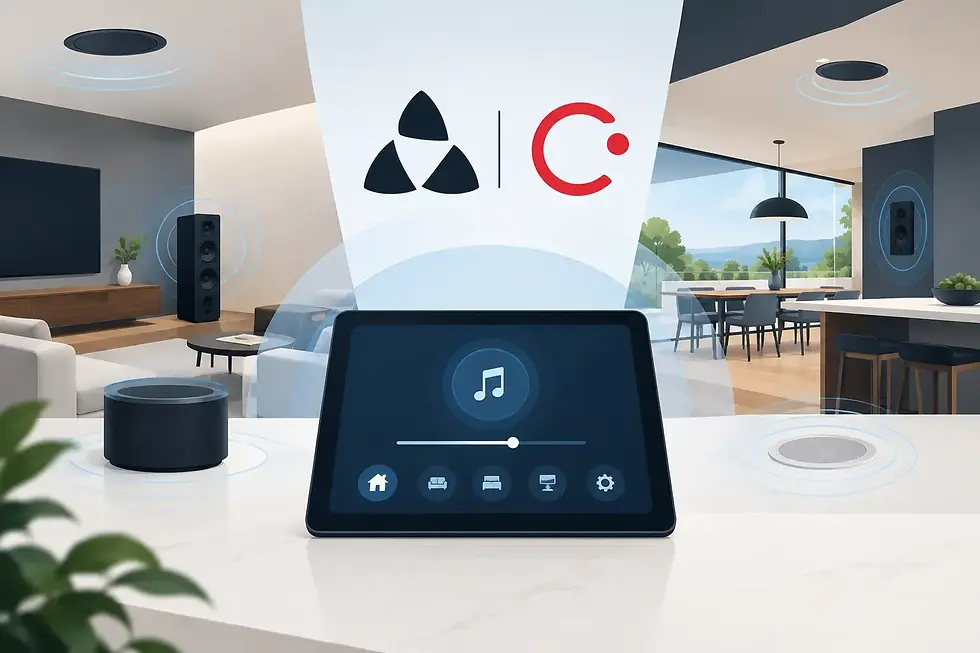
When those zones are integrated with Control4, the experience becomes much simpler than managing a collection of separate apps and remotes. A homeowner can start music in the kitchen, send it to the patio when guests move outside, adjust volume by room, or create a scene that brings together lighting, shades, climate, and audio. The technology stays sophisticated behind the scenes while the interface remains intuitive.
Traditional speakers can be part of that same connected system. They are often excellent choices for a dedicated stereo zone, a high-impact theater front stage, or a room where placement can be optimized. A hybrid approach is common: architectural speakers throughout the home, paired with carefully selected traditional speakers in one performance-focused space.
Theater Performance: Where the Details Matter Most
For a dedicated home theater, the decision should be driven by the complete room design. In-wall front, center, and surround speakers can create a clean cinema aesthetic, particularly when installed behind an acoustically transparent projection screen. This allows the dialogue channel to sit at the correct height behind the image, helping voices feel naturally connected to the action on screen.
Traditional speakers may be preferable when the theater doubles as a serious two-channel listening environment or when the selected speaker design benefits from more cabinet volume. They also offer a straightforward path for enthusiasts who anticipate changing speakers over time.
In either case, subwoofers deserve equal attention. Deep, controlled bass is not just about impact during action scenes. It adds scale to music, realism to environmental effects, and a sense of physical presence that smaller speakers alone cannot provide. Proper subwoofer placement and calibration often make a greater difference than moving from one respectable speaker category to another.
How to Choose for Your Home
Start with the room, not the speaker. Consider whether the space is primarily for background music, focused listening, family movie nights, serious cinema, or entertaining. Then consider the visual standard for the room, the stage of construction, and how much flexibility you want after installation.
Choose Triad in-wall speakers when a refined architectural result, consistent multi-room coverage, and an integrated theater design are priorities. Choose traditional speakers when visible craftsmanship, easy repositioning, or a dedicated audiophile setup matters most. Consider a combination when your home has different needs in different rooms.
SmartHome-Techs can help translate those priorities into a system that feels considered from the first conversation through final calibration. The right speaker plan should support the room you have now while allowing the home to evolve around it.
A speaker system earns its place when you stop thinking about the equipment and simply enjoy the soundtrack of the room: a favorite record over dinner, clear dialogue during movie night, or music that follows the afternoon from the kitchen to the patio.
Comments