

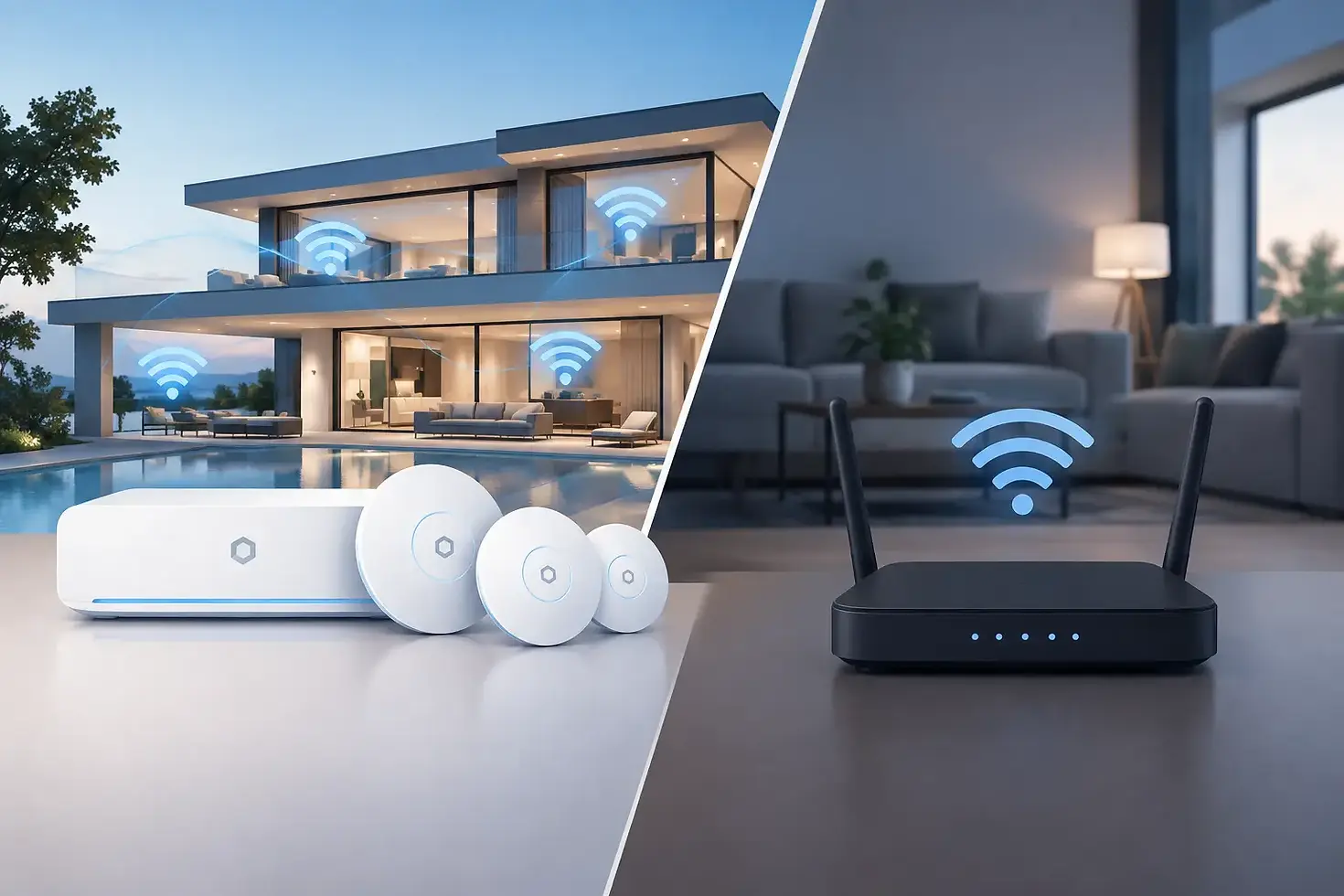
Araknis vs Consumer Wi-Fi for Luxury Homes

A home can have gigabit internet and still feel unreliable. A video doorbell pauses before loading, music drops on the patio, cameras go offline, or a Control4 touch screen takes too long to respond. That is the real question behind Araknis vs consumer Wi-Fi: why luxury homes need better networking. The issue is rarely the internet plan alone. It is whether the network was designed to support the way the home is actually used.
For a luxury residence in South Florida or Colorado, Wi-Fi is no longer a convenience layer. It is the operating foundation for lighting, climate, entertainment, surveillance, security, voice control, remote access, and the personal devices everyone brings into the home. A professionally designed network gives those experiences the consistency they deserve.
Why consumer Wi-Fi reaches its limits
Consumer Wi-Fi systems are built for broad appeal: an easy setup, a reasonable price point, and coverage for an average home. For an apartment, a smaller house, or a household with modest streaming and smart-device needs, that may be entirely appropriate. A quality consumer mesh system can be a meaningful improvement over the router supplied by an internet provider.
Luxury homes present a different set of requirements. They often have multiple floors, concrete or masonry construction, metal finishes, expansive outdoor areas, guest suites, detached structures, dedicated theaters, and equipment located far from where the family spends time. Those details affect wireless performance far more than a router’s advertised speed rating.
Then there is device volume. A connected home may include dozens of lighting loads, thermostats, keypads, cameras, audio endpoints, televisions, mobile devices, gaming systems, appliances, and voice assistants. Not every device uses much bandwidth, but every device adds activity to the network. When several 4K streams, security-camera uploads, video calls, and automation commands occur at once, the network needs to manage traffic intelligently rather than simply broadcast a signal.
Consumer equipment can also make troubleshooting difficult. When performance changes, homeowners are often left rebooting hardware, moving mesh nodes, changing settings in multiple apps, or waiting for an issue to return before anyone can diagnose it. That is not the level of control most homeowners expect from a carefully designed property.
Araknis vs consumer Wi-Fi: the meaningful difference
Araknis networking is designed for professionally installed systems and for the realities of connected homes. It is not just a stronger Wi-Fi signal. It is a coordinated network architecture that can include a router, managed switches, wired and wireless access points, and remote management capabilities selected for the property.
The distinction matters because Wi-Fi is only one part of the network. Wireless access points deliver coverage where people use devices. Switches connect fixed devices such as televisions, controllers, cameras, and audio components. The router manages the connection between the home and the internet, while helping control traffic inside the network. Each component must be chosen and placed with the whole system in mind.
Coverage is planned, not guessed
A consumer mesh kit generally assumes that a few units placed around the home will find their own best path back to the main router. That can work well in open spaces, but wireless links between mesh nodes may lose performance through dense walls, long distances, or interference.
With an Araknis-based design, access point locations can be planned around the architecture, materials, and use of each space. Whenever practical, access points are hardwired back to the network rather than relying on a wireless hop between nodes. This preserves capacity for phones, tablets, streaming devices, and smart-home equipment.
The result is not simply better signal bars. It is more predictable performance in the primary suite, home office, theater, pool area, patio, garage, and guest spaces. In a large home, that predictability is what makes technology feel effortless rather than temperamental.
Wired connections protect the wireless experience
Many high-demand devices do not need to compete for Wi-Fi at all. A professionally designed network can provide wired connections for media players, televisions, gaming systems, Control4 controllers, network video recorders, and access points. This reduces congestion and gives essential systems a more stable path.
That design decision is especially valuable in a home theater. Streaming a movie is one thing; maintaining reliable control of an AV receiver, projector, lighting scene, and media source is another. The network should support the full experience without requiring family members or guests to think about how the system is connected.
Management and visibility change the ownership experience
The advantage of a professional network becomes most apparent when something needs attention. Managed Araknis systems can be monitored and supported remotely through tools such as OvrC, allowing an integrator to view connected equipment, identify common issues, and in many cases address them without an unnecessary service visit.
Remote visibility does not eliminate every problem. An internet outage, damaged cable, failed device, or major change to the home may require on-site service. It does, however, give the support team a clearer starting point than a homeowner’s report that “the Wi-Fi seems slow.” That saves time and minimizes disruption.
For second-home owners, this capability is particularly valuable. Whether you are in Denver while your property is in Boca Raton, or traveling while cameras and climate systems remain active, a supportable network adds practical confidence to remote home management.
Networking affects every smart-home system
A smart-home platform should simplify daily life, not create a collection of isolated apps. Control4 brings lighting, shades, security, climate, entertainment, and more into a unified experience, but the network beneath it must be dependable enough to carry those commands consistently.
Consider an evening arrival scene. The gate opens, selected lights turn on, the temperature adjusts, and music begins in the main living area. None of these actions is unusually demanding on its own. Together, they depend on network devices communicating at the right moment. The same is true when reviewing camera footage, answering a door station, starting a movie, or checking a vacation property from another state.
A well-designed network also supports privacy and organization. Professional configuration can separate categories of traffic where appropriate, such as primary household devices, guests, and certain connected products. The right approach depends on the equipment and the homeowner’s goals, but the principle is straightforward: not every device needs the same access or priority.
What a professional network design should consider
There is no universal access point count or one-size-fits-all equipment package. A penthouse, an oceanfront estate, a mountain home with thick construction, and a new build with extensive outdoor living all call for different planning.
A proper design starts with how the home will be lived in. The integrator should evaluate square footage, floor plan, building materials, structured wiring, internet service, outdoor coverage, security requirements, entertainment zones, and the expected number of connected devices. They should also account for future needs, including additional cameras, a detached guest house, expanding audio zones, or a planned theater upgrade.
New construction offers the best opportunity to install structured cabling before walls are closed. Running cable to anticipated access point locations, televisions, offices, camera positions, and equipment racks creates options that are difficult and more costly to add later. Existing homes can also be improved substantially, but the best solution may balance ideal placement with architectural and design considerations.
Equipment placement deserves the same attention as speaker placement or lighting design. A network rack should be accessible, ventilated, protected by appropriate power management, and organized so service does not disturb finished spaces. The technology can remain largely out of sight while still being easy to maintain.
Is Araknis always the right choice?
Not necessarily. If a home is small, has few connected systems, and only needs reliable browsing and streaming, a well-selected consumer Wi-Fi system may be sufficient. Spending more than the property requires is not good design.
But when a home depends on integrated technology, has challenging construction, supports extensive entertainment and surveillance, or needs professional service after installation, the value equation changes. The investment is not only in hardware. It is in thoughtful planning, clean installation, documented configuration, and a support path that respects the home and its owner.
Internet speed still matters, too. No internal network can make a slow or unstable internet connection perform like a premium fiber service. A qualified integrator can help distinguish between a provider issue, a Wi-Fi coverage issue, and a device-specific issue so the solution addresses the real cause.
Better networking is a better home experience
Luxury is often felt in the moments when nothing calls attention to itself: the movie starts immediately, the camera view appears when requested, the music follows the gathering outdoors, and the home responds as expected. Those experiences begin with the network.
SmartHome-Techs designs connected-home infrastructure around the property, the technology within it, and the way each household wants to live. When networking is treated as a core part of the home rather than an afterthought, every connected experience has a stronger foundation.
Comments