

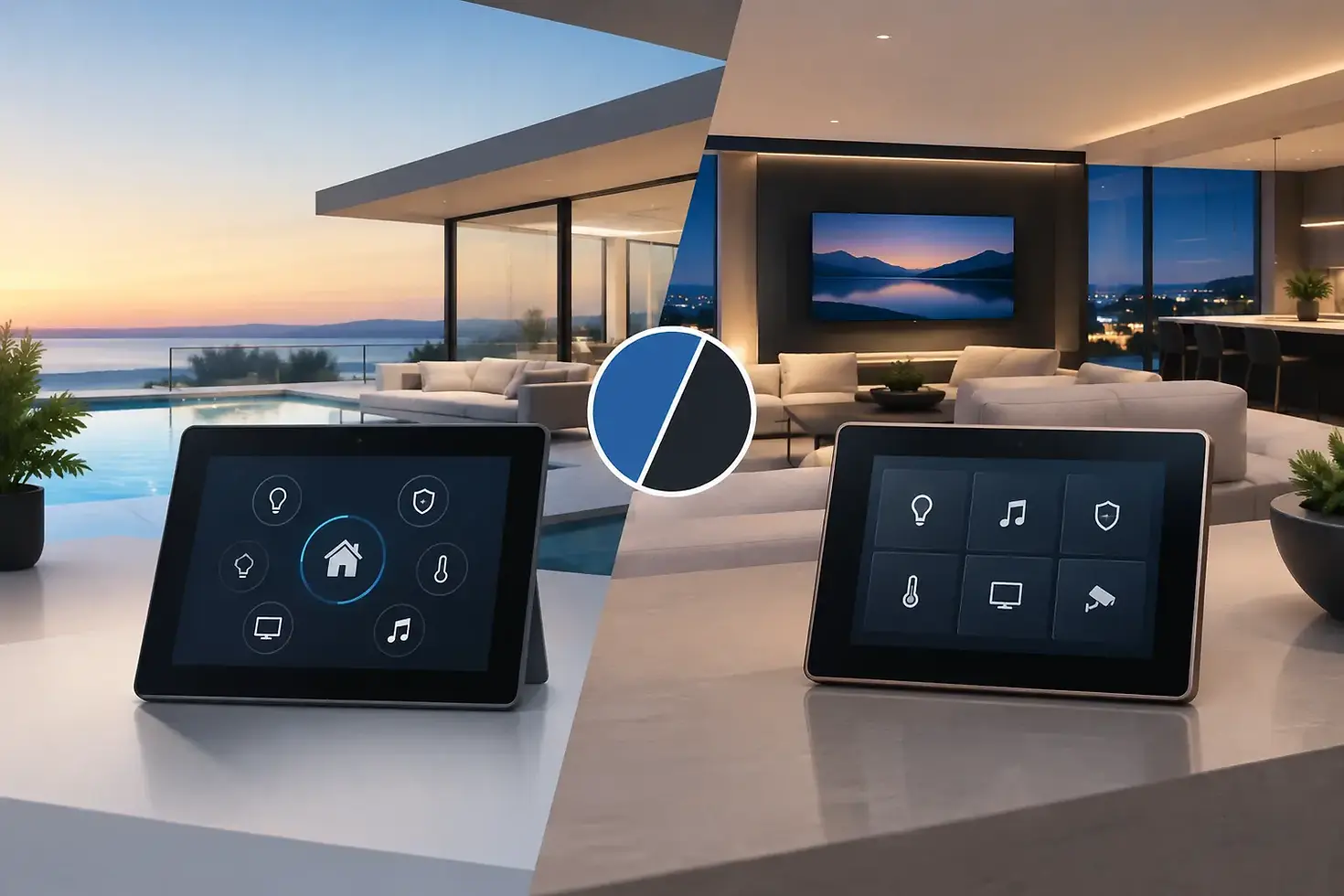
Control4 Versus Savant Systems for Luxury Homes

A luxury home can have exceptional lighting, a beautiful theater, motorized shades, cameras, climate control, and whole-home audio - yet still feel complicated if every system lives in a different app. Comparing Control4 versus Savant systems is really a question of how you want your home to work: which platform best turns those individual technologies into a personal, dependable experience.
Both are professionally installed smart-home platforms with strong reputations in high-end residences. Both can bring entertainment, comfort, security, and remote access into a unified environment. The right choice depends less on a feature checklist than on the home’s technology mix, the level of customization you expect, and the support you want long after installation.
Control4 Versus Savant Systems: The Core Difference
Control4 is built around broad integration and flexible whole-home control. It is designed to bring a wide range of connected products into one interface, including lighting, shades, AV equipment, thermostats, cameras, door locks, security components, and networked devices. Its strength is the ability to make a complex home feel straightforward without limiting the equipment choices behind the scenes.
Savant is also a premium, dealer-installed platform, often recognized for its polished interface and strong connection to the Apple ecosystem. Its experience can be especially appealing to homeowners who already rely heavily on iPhone, iPad, Apple TV, and Siri. Savant places a clear emphasis on refined control and curated entertainment experiences.
Neither platform is automatically better in every home. A residence with diverse brands, a detailed automation plan, or future expansion in mind may favor Control4’s breadth. A homeowner committed to an Apple-centered environment and a particular Savant design approach may prefer Savant. Professional system design makes the difference in either case.
The Experience You See Every Day
A smart-home system succeeds or fails in the moments you use it without thinking. That may be when you arrive home with groceries, start a movie, check the driveway from another state, or ask the house to prepare for bedtime.
Control4 offers control through touchscreens, keypads, handheld remotes, mobile devices, and voice assistants. A well-programmed system reduces a long list of actions to a few natural choices. A “Goodnight” scene, for example, can turn off selected lights, lower shades, arm security, lock doors, set back the temperature, and leave a pathway light on upstairs.
Savant offers a visually polished app-led experience that many Apple users find familiar. It also supports elegant control options, including touch interfaces, remotes, and keypads. For some homeowners, the preferred interface will be the deciding factor. That said, the interface should never be evaluated in isolation. The quality of programming, network performance, and the physical controls placed throughout the home matter just as much as the app on your phone.
Physical Controls Still Matter
The best smart homes do not require everyone to reach for a phone. Professionally placed keypads and remotes give family members and guests immediate control without teaching them an app. They also provide a dependable fallback when a phone is charging, unavailable, or simply not the easiest tool for the moment.
Control4 is particularly effective when homeowners want consistent wall controls across many rooms and want those controls to trigger personalized scenes. Savant can provide this type of experience as well. The decision should be based on how the home will be used, not just how the technology looks in a showroom.
Integration and Product Flexibility
Integration is where Control4 often has a meaningful advantage. Many luxury homes combine products from different categories and manufacturers: a preferred lighting system, a specific brand of surveillance camera, legacy AV equipment, pool controls, gate access, motorized shades, and specialty outdoor technology. Control4’s extensive compatibility ecosystem gives an experienced integrator more freedom to unite these pieces into one practical system.
That flexibility is valuable for existing homes, where the goal may be to improve control without replacing quality equipment that is already installed. It is equally useful in new construction, where architects, designers, builders, and technology professionals need to coordinate many systems before walls are closed.
Savant supports a substantial range of premium smart-home products, but its approach may be more selective depending on the device category and desired integration. That is not inherently a disadvantage. A more curated ecosystem can suit a carefully defined project. However, homeowners with specialized equipment or plans to add third-party technology over time should ask detailed compatibility questions early.
Custom Automation: Where a House Becomes Personal
The value of either platform is not simply that it controls devices. It is that it responds to the way you live.
Control4 supports detailed programming that can connect multiple systems around routines, schedules, occupancy, time of day, and security events. Morning scenes can bring up selected lighting, adjust temperature, and play music in the kitchen. Entertaining scenes can set a warmer lighting level across indoor and outdoor spaces, activate landscape audio, and simplify TV or theater controls. When a camera detects activity at a side gate, the system can send an alert and illuminate an exterior path.
Savant can also create sophisticated scenes and automation. The practical question is how far you want to take those automations and how many product categories they need to coordinate. Homes with layered requirements often benefit from Control4’s flexibility and the depth of its professional programming environment.
Customization has a trade-off: more capability requires more thoughtful planning. An automation should feel helpful, not surprising. The best design begins with daily habits, family preferences, and the home’s architecture, then uses technology only where it improves the experience.
Entertainment, Lighting, and Security
Both platforms can serve as the command center for distributed audio, video, theaters, lighting, shades, climate, and security. The distinction is often found in the details of the project.
For whole-home entertainment, Control4 can provide one familiar way to select music, streaming content, TV sources, and room-by-room audio. A family room, patio, gym, and primary suite can each have their own entertainment, or they can share the same music for an event. A dedicated theater can be set with one command: lights dim, shades close, projector starts, surround sound activates, and the source appears.
For lighting and shades, both platforms can support scenes that improve comfort, energy awareness, privacy, and architectural impact. A skilled design team will consider keypads, fixture types, window orientation, and how natural light changes throughout the day - not simply add automation after the fact.
For security, unified access to cameras, locks, sensors, and alerts creates practical peace of mind. Remote viewing is useful, but the real benefit is context. A homeowner should be able to see who is at the door, unlock it for a trusted visitor, and receive meaningful notifications without sorting through separate applications.
Reliability Depends on Design, Not the Logo
A professionally integrated smart home is only as reliable as its underlying infrastructure. That includes wired and wireless networking, equipment ventilation, power protection, rack organization, device placement, and thoughtful programming. No control platform can compensate for weak Wi-Fi coverage or an overloaded network.
This is why the integrator matters as much as the platform. The team should assess coverage across the full property, plan for high-bandwidth video and audio, protect critical equipment, label and document the installation, and provide a clear service path. For seasonal residences in South Florida or Colorado, remote monitoring and support can be especially valuable when the home is unoccupied.
Control4’s remote management capabilities give qualified dealers a practical way to diagnose many issues, update systems, and support clients without an unnecessary site visit. Savant installations can also be supported professionally, but homeowners should compare the ongoing service model, response expectations, and local expertise before making a decision.
Which System Is the Better Fit?
Control4 is often the stronger choice for homeowners who want broad third-party compatibility, tailored automation across many systems, consistent physical controls, and a platform that can expand with the property. It is especially well suited to larger homes, renovation projects with existing equipment, and new builds where technology needs to coordinate with lighting design, architecture, security, and entertainment from the start.
Savant may be an excellent fit for households that strongly prefer an Apple-oriented experience and have a technology plan that aligns with its supported ecosystem. Its refined presentation and entertainment focus can be compelling when the project scope and product selection are clearly defined.
For either platform, request a demonstration based on your actual routines. Ask how the system will handle arrivals, departures, guests, bedtime, remote access, power outages, internet interruptions, and future additions. A compelling demo should show more than individual devices turning on and off. It should show how the home will feel easier to live in.
At SmartHome-Techs, the planning conversation starts with that lived experience: how your spaces are used, what should happen automatically, and where simple control will have the greatest impact. The right system is the one that remains intuitive as your home, family, and expectations evolve.


Comments